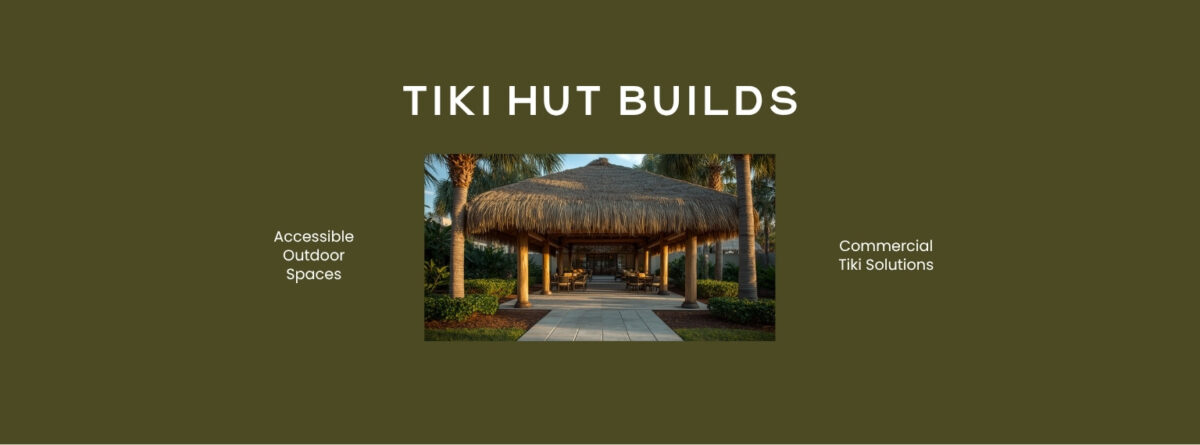
If you run a restaurant, resort, RV park, or HOA amenity area anywhere in Southwest Florida, your next outdoor project has to clear a hurdle most owners do not think about until a plans examiner brings it up. An ADA compliant commercial tiki hut build is not simply a courtesy to guests who use wheelchairs, walkers, or canes. For most commercial properties it is a federal requirement, and accessibility is one of the most common reasons a gorgeous thatched structure gets flagged at final inspection.
We have been building authentic cypress-pole and sabal palm frond tiki huts across Florida for decades, for backyards and for commercial clients from Naples to Ave Maria. This guide covers what accessibility actually means for an open-air thatched structure, where owners get caught out, and why designing it in from day one costs a fraction of retrofitting it later.
Does Your Commercial Tiki Hut Have to Be ADA Compliant?
The short answer for most business owners is yes. Title III of the Americans with Disabilities Act covers places of public accommodation, which includes restaurants, bars, hotels, resorts, marinas, campgrounds, and retail. If the public can walk into the space and buy something, sit down, or be served, the accessibility rules generally follow. A tiki hut shading a resort pool deck in Marco Island is part of that guest experience, and it is treated accordingly.
A tiki hut in a private backyard is a different animal. Residential builds are not governed by Title III, though your county still has plenty to say about permitting, setbacks, and wind load. The gray zone is community property. Amenity structures at a clubhouse, pool, or common area frequently do trigger accessibility requirements, which is why we walk boards through it carefully when we design commercial tiki huts for HOA communities and condo associations. Short-term rental properties in Naples and Estero can land here too, depending on how the property is operated and marketed.
The governing document is the 2010 ADA Standards for Accessible Design, which Florida layers its own accessibility code on top of. Your local building department is the final word, and we always recommend confirming specifics with them or your design professional before construction.
Four Details That Decide Whether You Pass Inspection
Most accessibility problems on an ADA compliant commercial tiki hut build are not exotic. They come down to four things, and every one of them is far cheaper to solve on paper than in the field.
An accessible route that actually reaches the hut. A guest needs a continuous, firm, stable, slip-resistant path from the parking area or main building to the structure. This is where Florida properties trip up constantly: loose sand, shell, and pea gravel look wonderful around a tiki bar and are not an accessible surface. Compacted stabilized surfacing, broom-finished concrete, or a properly built deck solves it.
Level changes handled correctly. Under the standards, a change in level up to a quarter inch can be vertical, between a quarter and a half inch must be beveled, and anything greater needs a ramp. Ramps run a maximum slope of 1:12 with a maximum rise of 30 inches per run, plus landings. On raised pool decks and elevated waterfront platforms this is the single biggest design driver.
Clear width and maneuvering room. The accessible route wants at least 36 inches of clear width, with room to turn once someone is under the roof. Post spacing matters here, and it is one of the real advantages of a custom build over a kit: we can set the cypress poles where the traffic pattern needs them instead of working around a fixed template.
Counter and table heights. This is the one that surprises tiki bar owners. A standard tiki bar top at 42 inches is not an accessible surface. The standards call for accessible dining and work surfaces between 28 and 34 inches above the floor, with knee clearance beneath, and a portion of seating provided at that height. The usual solution is a lowered section of bar top integrated into the design so it looks intentional rather than bolted on. Done well, nobody reads it as a compliance feature.
One question we field constantly from restaurant and resort owners is how much room is really needed underneath. In practice, if you can move a wheelchair comfortably from the accessible route to a seat at the lowered bar section without weaving between poles, you are in good shape. That usually means planning at least a 36-inch clear path all the way through, a turning space inside the footprint, and knee clearance of roughly 27 inches high and 30 inches wide beneath any accessible table or counter section. Getting these numbers right on the drawing is the whole game.
Accessible Tiki Structures in Naples, Marco Island, Estero and Ave Maria
Southwest Florida throws its own wrinkles into accessible outdoor seating. In Naples, Fifth Avenue and Third Street restaurants are often working in tight, established footprints where an accessible route has to thread past existing landscaping and outdoor dining. In Marco Island, canal-front and beachfront properties frequently sit at flood elevations that force a raised deck, which means a ramp or lift becomes part of the conversation from the first sketch.
Estero is largely new construction, and that is the easy case: when the tiki structure is designed alongside the hardscape, accessibility costs almost nothing extra. Ave Maria, as a master-planned community, tends to have consistent standards across amenity areas, and boards there usually want the tiki structure to match what the rest of the community already meets.
Accessibility also has to coexist with everything else Florida demands of an outdoor structure. Your accessible route cannot conflict with setback requirements by Florida county, and the structure still has to satisfy wind load and tie-down requirements. Those are not competing goals, but they do need to be solved together rather than in sequence. When we produce 3D renderings for a commercial client, the accessible route is drawn in from the start, right alongside the pole layout and the roof pitch, which is also how we approach tiki hut designs for Florida restaurants and resorts.
Storm durability deserves a mention alongside accessibility, because the two get engineered together. A ramp, a raised deck, and the tie-down system all share the same foundation work, and it is far cheaper to pour once. Our approach to tiki hut wind resistance in Florida storms is built into the same structural drawings that carry the accessible route, so an ADA compliant commercial tiki hut build does not quietly compromise the structure to make room for a ramp.
What It Costs, and Where Owners Overspend
Designed in from the beginning, accessibility on an ADA compliant commercial tiki hut build is usually a modest line item. You are adjusting pole placement, specifying the right ground surface, and detailing a lowered bar section. The material cost difference on the structure itself is often minor.
Retrofitting is where the money goes. Pouring a new accessible path after the fact, rebuilding a bar top, or adding a ramp to a deck that was never designed for one can easily cost several times what the same decisions would have cost during design. Worse, a complaint or a failed inspection can shut down the seating area during peak season, and in Southwest Florida the peak season is the whole business model.
The other expensive mistake is assuming an open-air structure is somehow exempt because it has no walls and no door. It is not. If your guests use it, it is part of your facility.
Build It Right the First Time
An ADA compliant commercial tiki hut build is genuinely straightforward when accessibility is part of the design brief instead of a correction. We handle commercial and residential projects across the entire state, we build with authentic cypress poles and hand-tied sabal palm fronds, and we produce 3D renderings so you and your plans examiner can see exactly how the accessible route, the seating, and the structure work together before anyone breaks ground.
If you are planning a project in Naples, Marco Island, Estero, or Ave Maria and want it done properly the first time, call 1-877-249-4038 or request a free tiki hut quote. You can also browse our work and service areas at Big Kahuna Tiki Huts.