
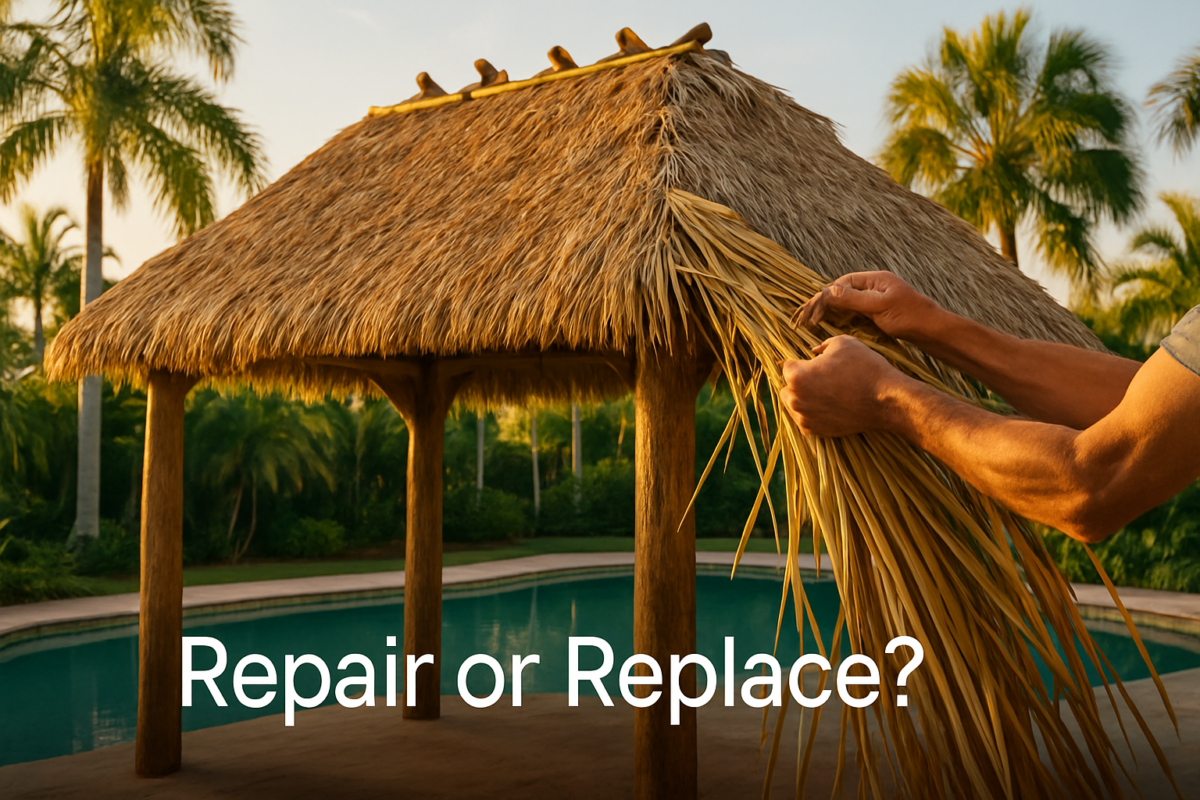
If you own a tiki hut or tiki bar anywhere from Naples to Fort Myers, you already know how much character a hand-thatched palm roof adds to a backyard, pool deck, or commercial patio. You also know that South Florida’s sun, salt air, wind, and rain are relentless. Sooner or later, every palm-frond roof reaches the point where the question stops being “does it still look good?” and starts being “do I patch it, or replace the whole thing?” This guide on tiki hut rethatching repair in Florida walks you through exactly how to tell the difference — and what to expect either way.
At Big Kahuna Tiki Huts, we’ve been rebuilding and restoring chickee-style roofs across Southwest Florida for decades. We’ve seen what survives a hurricane and what doesn’t, what looks tired but has years of life left, and what’s quietly rotting from the inside. Here’s the same honest framework we use when we walk a property in Naples, Marco Island, Cape Coral, or Fort Myers.
How Long Should a Palm-Frond Roof Last in Florida?
A properly built sabal palm roof typically lasts 7 to 12 years in Florida, depending on three things: the quality of the original thatching, sun exposure, and how close the structure is to salt water. Inland properties tucked under tree cover get the most life; oceanfront commercial properties in Marco Island or beachfront homes in Fort Myers Beach are usually on the shorter end of that window.
Cypress posts and structural framing, on the other hand, can last 25 years or more when properly milled and installed — which is why a roof can wear out long before the bones of your tiki hut need any attention at all. That distinction is what makes rethatching such a smart investment: you’re not rebuilding the hut, you’re refreshing the part that takes the weather.
5 Signs Your Tiki Hut Needs Rethatching Repair
Before deciding between a spot repair and a full re-thatch, take a walk around your hut on a sunny afternoon. Here’s what to look for:
- Visible daylight through the roof. Pinholes are normal in a brand-new thatch; large patches of sky are not. If you can see distinct shafts of sunlight on the ground beneath the hut at noon, your fronds have thinned out.
- Dripping or “rain dust” after a storm. A healthy palm roof sheds water in sheets. If you’re getting active drips — or fine wet debris falling from above during rain — water is finding paths through the layers.
- Brittle, gray, or crumbling fronds along the edges. The bottom rows take the worst of the sun. When they start snapping off in your hand instead of bending, the UV damage is widespread.
- Sagging sections or visible “valleys” in the roofline. Sagging usually means the underlying ties have rotted or the fronds above have compressed. Either way, it’s a structural concern, not just a cosmetic one.
- Storm damage from a recent named storm. Even a glancing tropical storm can lift edge fronds, break tie-downs, or expose ridge caps. Florida homeowners should get a quick post-storm inspection every season.
If you’re noticing one or two of these and the rest of the roof looks tight, you’re a strong candidate for a targeted tiki hut rethatching repair in Florida. If you’re nodding along to three or more, it’s time to talk about a full re-thatch.
Repair vs. Replace: How the Decision Actually Gets Made
Most homeowners assume that bigger problems automatically mean a full replacement and smaller problems mean a patch. In reality, the decision is driven by three questions:
1. How old is the existing roof? If your thatch is under five years old and you’ve got isolated damage from a single storm or a falling branch, a spot repair is almost always the right call. We can lace in new sabal fronds, retie sections, and color-match the patch so it disappears within a few weeks of weathering. If your roof is already 8+ years old, patching a small area only postpones the inevitable — and you’ll pay for the labor twice.
2. Is the damage at the ridge or along the edges? Ridge damage is serious. The ridge cap is the high point of the roof, and once water gets in there, it travels down through every layer. Edge damage is usually contained to the bottom courses and is much easier to repair without disturbing the rest of the thatch.
3. What’s the structure used for? A residential tiki hut over a poolside lounge area has different priorities than a commercial tiki bar at a Cape Coral marina or a Fort Myers restaurant. Commercial properties usually opt for full re-thatches on a planned schedule rather than emergency repairs, because every day of downtime affects revenue.
What’s Involved in a Professional Re-thatch
A true tiki hut re-thatch isn’t just “throwing new fronds on top.” When our crews show up at a property in Naples or Marco Island, here’s the typical sequence:
First, we inspect the cypress framing. If we find any compromised posts or beams — rare, but it happens — we address those before any thatch goes up. Then we strip the old fronds completely down to the structure. We re-tie the cross-laths with marine-grade fastening, then begin courses of fresh, hand-selected sabal palm fronds from the bottom up, overlapping each row generously so water has no way in. The ridge gets a custom cap, and the edges are trimmed clean for a finished look.
A typical residential re-thatch takes 1 to 3 days, depending on the size and pitch. Commercial structures can run a week or more. In every case, our crews leave the site clean — and your hut looking like the day it was built.
Why Authentic Materials Matter (and Why “Cheap” Rethatching Costs More)
Florida has plenty of contractors who’ll quote you a low number for a palm roof. What you usually don’t see in those quotes is what they’re using: imported synthetic fronds, mexican palm instead of native sabal, or staples instead of hand-tied lashings. Those roofs look fine on day one — and start failing in 18 months.
At Big Kahuna Tiki Huts, every project uses authentic cypress poles and native sabal palm fronds, hand-tied the traditional Seminole way. It’s the same construction method that’s stood up to a century of Florida weather on properties across the state, and it’s the reason our work is approved for both residential and commercial use under Florida’s chickee exemption.
Get a Free, No-Pressure Quote for Your Roof
Whether you’re in Naples, Marco Island, Cape Coral, or Fort Myers — or anywhere else in Florida — the easiest way to know whether you need a repair or a full re-thatch is to have an experienced builder take a look. We offer free inspections and free 3D renderings for new builds, and we’ll give you a straight answer about what your roof actually needs (not what would be easiest to sell you).
Take a look at our portfolio to see recent tiki huts and tiki bars we’ve built and restored across the state, learn more about Big Kahuna, or head straight to our contact page for a free quote.
Call us today at 1-877-249-4038 or visit palmhuts.com to get your tiki hut ready for another decade of Florida living.

