
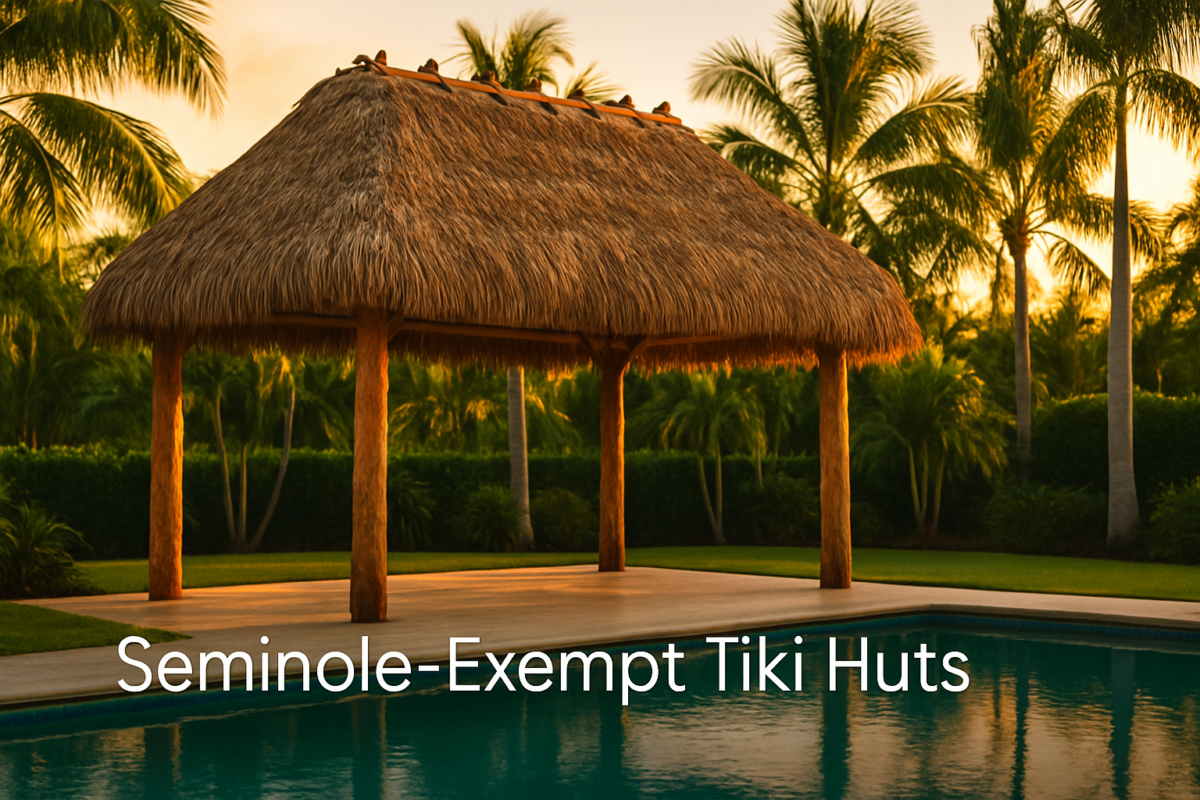
If you’ve started shopping for a backyard tiki hut in South Florida, you’ve probably run into a phrase that sounds more like government red tape than tropical paradise: “Seminole-exempt.” It comes up in permit conversations, contractor quotes, and HOA debates from Miami to Fort Lauderdale, and most homeowners only get a half-answer. So let’s clear it up. Understanding Seminole exempt tiki hut construction Florida rules is the difference between a quick, painless install and weeks of permit headaches — and it’s the single biggest reason authentic chickees remain so popular across Boca Raton, Pompano Beach, and the rest of South Florida.
At Big Kahuna Tiki Huts, we’ve been building authentic chickees up and down the state for decades, and “Is this Seminole-exempt?” is one of the first questions every smart homeowner asks. Here’s the straight answer.
What Seminole-Exempt Actually Means
Florida Statute 553.73(10)(c) carves out a specific exception in the Florida Building Code for traditional Native American chickees. In plain English: a chickee built using authentic materials and traditional methods by members of the Miccosukee Tribe or the Seminole Tribe of Florida is not subject to the Florida Building Code in the same way a permanent structure is. That’s why you’ll hear contractors and county officials use the shorthand “Seminole-exempt” or “chickee-exempt.”
To qualify, the structure must meet a clear definition: an open-sided wooden hut with a thatched roof of palm or palmetto fronds, no electrical wiring, no plumbing, and no non-wood structural features. It cannot have enclosed walls. It cannot be built on a permanent foundation that classifies it as a habitable structure. And — this part trips a lot of people up — it has to be built by a member of the Seminole or Miccosukee tribe to fall under the exemption.
That last requirement is exactly why working with the right builder matters. Not every “tiki hut company” qualifies. The team at Big Kahuna Tiki Huts partners with tribal craftsmen so the structures we deliver in South Florida actually meet the legal definition — not just the marketing one.
Why South Florida Homeowners Care About the Exemption
If you live in Miami-Dade, Broward, or Palm Beach County, you already know how strict the building permit process can be. Hurricane codes, setback rules, impact-resistant materials, engineering stamps — adding a permanent outdoor structure usually means a stack of paperwork and a few hundred to several thousand dollars in fees before a single post goes in the ground.
Seminole exempt tiki hut construction in Florida sidesteps most of that. Because authentic chickees fall outside the Florida Building Code, they typically don’t require a building permit in the traditional sense. That means:
- No long permit waits while your backyard sits in limbo
- No engineering plans drawn up for a non-permanent structure
- No permit fees stacking on top of the build cost
- Faster installation — most of our chickees go up in a day or two
For homeowners in Miami, Fort Lauderdale, Boca Raton, and Pompano Beach who want a real tiki hut over a pool deck, patio, or backyard lounge area, the exemption is what keeps the project simple and affordable.
What the Exemption Doesn’t Cover
Here’s where we have to be straight with you, because we’ve seen plenty of homeowners get burned by contractors who oversell the exemption. Seminole-exempt status applies to the chickee itself — the cypress posts and the woven palm-frond roof. It does not automatically override every local rule.
Specifically, you still need to think about:
- HOA covenants. If you live in a deed-restricted community in Boca Raton or a gated neighborhood in Fort Lauderdale, your HOA can still require approval for any backyard structure. The state exemption doesn’t change a contract you signed with your HOA.
- Local zoning and setbacks. Most South Florida counties still expect chickees to respect property line setbacks, easement boundaries, and pool safety zones. We always design around those rules.
- Electrical add-ons. The moment you add a ceiling fan, lights, an outlet, or a TV mount, you’ve added something that’s not exempt. Those electrical components require a separate permit and a licensed electrician — and we strongly recommend handling that the right way.
- Commercial use. Restaurants, resorts, and bars using a chickee as part of a business operation may face additional fire-marshal or health-department review depending on the city.
The good news: a quality builder walks you through every one of these before the first cypress pole is delivered. We’ve helped clients in Pompano Beach navigate HOA boards and worked with restaurant owners in Miami on commercial chickee installations. It’s part of the job.
How Authentic Construction Actually Works
People sometimes assume “Seminole-exempt” is a loophole — like the structure must be flimsy to qualify. The opposite is true. Authentic chickees have weathered Florida storms for centuries because the construction is genuinely engineered for this climate.
The core of every Big Kahuna chickee is hand-selected cypress poles, sourced and prepared the traditional way. Cypress is naturally rot-resistant and stands up to humidity, salt air, and termites better than pressure-treated lumber. The roof is woven from sabal palm fronds, layered thick enough that a properly built chickee sheds water like a duck’s back and provides genuine shade — often 15 to 20 degrees cooler underneath than open sun.
Authentic Seminole exempt tiki hut construction in Florida means:
- Cypress posts set deep into the ground, not bolted to a slab
- Hand-tied frond layers — not sprayed-on imitation thatch
- Open sides with no enclosed walls
- No nails or fasteners visible in the traditional thatch work
The reward for doing it right is a structure that often lasts 8 to 12 years on the original thatch (longer with a re-thatch), looks better the older it gets, and adds real value to your property.
Choosing the Right Builder for Your South Florida Property
The Seminole exemption is a powerful advantage, but only if your builder genuinely qualifies. Before you sign a contract, ask three questions:
- Are the chickees built by members of the Seminole or Miccosukee tribe? (If the answer is vague, walk away.)
- What materials are used for the posts and the roof? (You want cypress and sabal palm, not pine and synthetic thatch.)
- Can I see local installations and references? (Reputable Florida builders will have plenty.)
Big Kahuna Tiki Huts has been answering those exact questions for residential and commercial clients across Miami, Fort Lauderdale, Boca Raton, and Pompano Beach for years. We provide free 3D renderings before construction so you can see exactly how the chickee will fit your space, and our portfolio includes everything from intimate poolside huts to full commercial tiki bars. Take a look at our portfolio to see what’s possible.
Ready to Plan Your Chickee?
The Seminole-exempt rule is one of the few corners of Florida construction law that actually makes life easier for homeowners — but only when you work with a builder who understands and respects the requirements. Whether you’re picturing a backyard escape in Boca Raton, an entertainment hub in Fort Lauderdale, a poolside retreat in Miami, or a commercial bar in Pompano Beach, an authentic chickee delivers tropical character that no permitted pavilion can match.
Call Big Kahuna Tiki Huts at 1-877-249-4038 or visit palmhuts.com for a free quote. We’ll walk you through the exemption, the design, and the timeline — and you’ll have a real tiki hut in your backyard before you know it.

