Categories
Tiki Blog

Tiki Hut Rethatching Repair in Florida: When to Patch vs. Replace Your Palm Roof

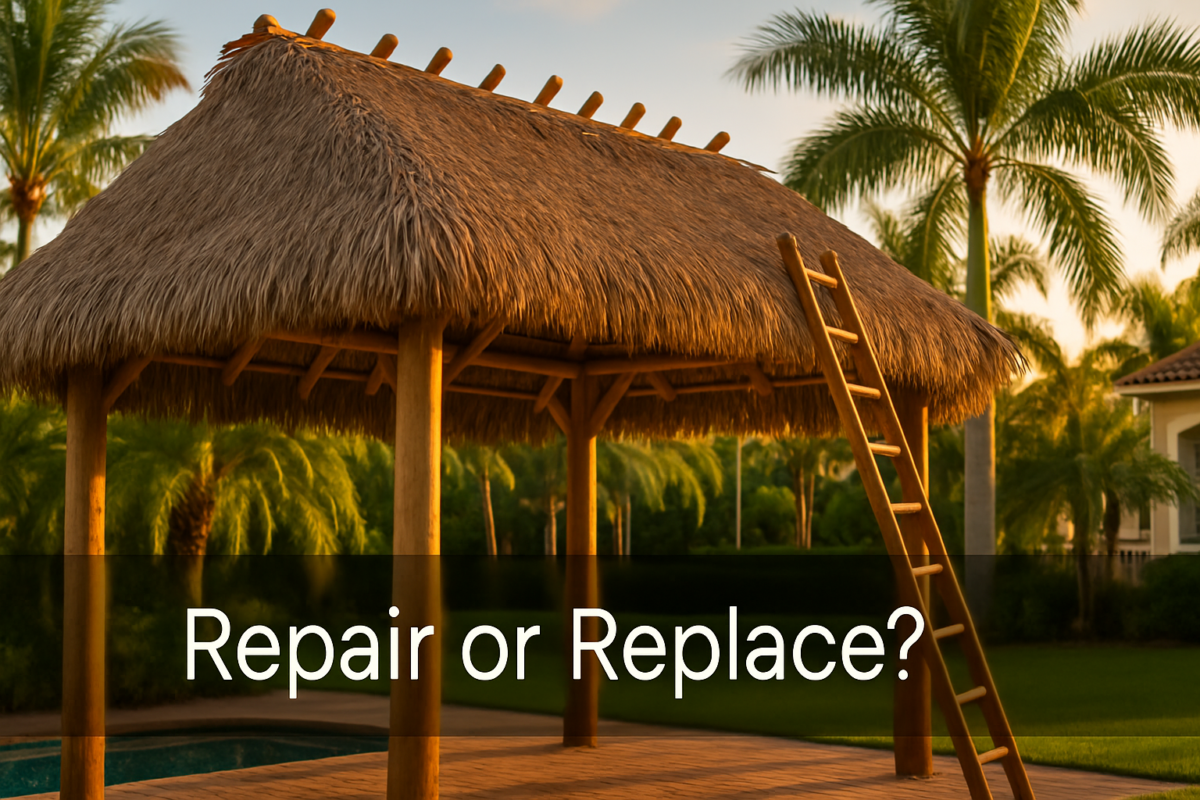
If you own a tiki hut in Southwest Florida, you already know our slice of paradise has a way of wearing things out. Salt air, summer downpours, blazing UV, and the occasional tropical storm all team up against your sabal palm thatch. The good news? A tiki hut roof is built to be revived. The trick is knowing when a quick patch will do and when a full re-thatch is the smarter investment.

After decades of building, refreshing, and rescuing tiki huts from Naples to Marco Island and across Cape Coral and Fort Myers, we’ve seen every stage of palm-roof aging. This guide walks you through what’s actually happening up there, the telltale signs to watch for, and how to decide between a targeted tiki hut rethatching repair Florida homeowners often need and a full rebuild.

How a Florida Tiki Hut Roof Actually Wears Out

A genuine chickee-style hut isn’t just decorative. Hand-tied sabal palm fronds shed rainwater, vent heat, and shrug off humidity — but they’re a natural material, and like any natural material baking under the Florida sun, they have a lifespan.

Three forces drive the aging process. UV exposure dries out the upper layer of fronds, turning them silvery-gray over time. That patina is normal — but underneath, the fibers are slowly losing flexibility. Wind events, especially the Gulf-side gusts that hit Naples and Marco Island during summer storms, work loose the outermost row of palm tips. Once a few fronds break free, water gets behind the remaining layers and accelerates wear. And finally, animal activity — squirrels, birds, the occasional raccoon — can pull individual fronds out as nesting material. One pulled frond won’t sink your roof, but ten will.

The combined effect is gradual. Most well-built tiki huts in our climate need a touch-up every 3 to 5 years and a full rethatching every 8 to 12 years, depending on exposure.

Signs You Just Need a Rethatching Repair

Not every tired-looking tiki hut needs a tear-down. In fact, most of the rethatching calls we get from Cape Coral and Fort Myers turn out to be repairs, not replacements. Here are the signs that point toward a targeted fix:

Localized thinning. If only one face of the roof — usually the windward side — looks patchy while the rest still has body, you almost certainly need a partial tiki hut rethatching repair Florida specialist can blend right into the existing thatch. Done well, the seam disappears within a season.

Small leaks during heavy rain. Pinhole drips in one or two spots usually mean a few fronds have shifted. A trained crew can lift and re-tie the affected section, weave in fresh sabal palm, and have you weatherproof again within a day.

Storm damage. After a tropical system or strong squall, you may notice fronds peeled back at the edges or a lifted ridge. That kind of damage is almost always repairable when it’s caught quickly. The longer it sits open, the more underlying material gets compromised — so the speed of your call matters more than the size of the damage.

If you’re seeing any of these signs in the Naples or Marco Island area, a single-visit repair can save you from a much larger expense down the line.

When Full Replacement Beats Patching

There comes a point where patching only delays the inevitable. Here’s how we know it’s time for a full re-thatch instead of another repair:

Roof-wide thinning. When the thatch has lost its body across the entire structure — you can see daylight through it from underneath, or it has that “tired pillow” sag — patching just adds weight to a structure that’s ready for a clean start.

Repeated leaks in different spots. If you’re chasing leaks every rainy season and they keep popping up in new places, the underlying weave has failed. Layering fresh fronds on top of a failing base traps moisture and shortens the life of the new work.

Old-style construction. Some older tiki huts in Cape Coral and Fort Myers were originally built with non-cypress posts or with thinner thatch density than today’s standards. When you’re already calling for repairs, it’s worth upgrading to authentic cypress poles and a denser sabal palm canopy at the same time. The math almost always favors the upgrade.

Visible structural concerns. Bowing rafters, cracked posts, or rusted strapping mean the issue isn’t just the roof. A full rebuild lets us inspect the bones, replace anything compromised, and re-thatch on a structure you can trust for the next decade.

A complete rethatching project takes 1 to 3 days for most residential huts and gives you a brand-new appearance, full water-tightness, and a reset on the maintenance clock — usually for less than the cost of multiple back-to-back repairs.

How Big Kahuna Approaches Tiki Hut Rethatching Repair in Florida

When our crew rolls into Naples, Marco Island, Cape Coral, or Fort Myers for a rethatching job, the process is the same whether you’ve called for a quick repair or a full replacement.

We start with an in-person inspection. A photo can hint at the issue, but Florida’s salt air and humidity hide damage in ways that only an in-hand evaluation reveals. From there, we walk you through what we found, what’s salvageable, and what isn’t — no upselling, no guesswork.

Authentic materials make the difference. We only use cypress poles and hand-tied sabal palm fronds with proper Florida sourcing. Cypress resists rot in a way pressure-treated lumber simply doesn’t, and authentic sabal palm has a natural oil that sheds water far better than mass-produced synthetic thatch. If your project needs structural work, we’ll also bring 3D rendering to the conversation so you can see exactly what your refreshed hut will look like before we touch a single frond. It’s a small thing that takes a lot of stress out of the decision — and it’s why so many homeowners across Southwest Florida choose us when their tiki hut rethatching repair Florida options feel overwhelming.

Maintenance Tips to Stretch the Life of Your Palm Roof

You can add years to your tiki hut between rethatching jobs with a few simple habits:

Trim back overhanging branches. Anything that drops debris or rubs the thatch is shortening its life. A 4-foot clearance around the entire roof line is a good rule.

Rinse off salt buildup once or twice a year, especially if you’re on the water in Marco Island or near the Gulf in Naples. A garden hose at low pressure is enough — never a pressure washer.

Schedule a quick inspection every 2 to 3 years. We can spot small issues before they become repair-or-replace decisions, and a 30-minute walkaround often pays for itself many times over.

Don’t ignore wildlife. If birds or squirrels are pulling at the thatch, address it early — bird netting along the ridge or a small deterrent can prevent a slow-motion disaster.

These small steps keep your hut looking sharp and push every dollar of your original investment further into the future.

Repair, Replace, or Just Get a Look — We’re Here to Help

Tiki hut rethatching is part art, part craftsmanship, and 100% about understanding the Florida climate it has to live in. Whether your roof needs a touch-up after a stormy season or a full refresh after a decade of faithful service, the right call starts with an honest evaluation. A trustworthy tiki hut rethatching repair Florida partner will tell you when patching is plenty — and when it isn’t.

Big Kahuna Tiki Huts has been building, repairing, and rethatching authentic tiki huts and tiki bars across Southwest Florida — including Naples, Marco Island, Cape Coral, and Fort Myers — for decades. We bring authentic cypress poles, hand-tied sabal palm, decades of field experience, and the same care to a single repair as we do to a full commercial build.

Ready to talk through your project? Call us at 1-877-249-4038 or visit palmhuts.com for a free, no-pressure quote. You can also browse our portfolio to see recent rethatching work, learn more about our team, or contact us directly. Your tiki hut still has plenty of paradise left in it — let’s make sure it stays that way.
Categories
Tiki Blog

What Does Seminole-Exempt Mean for Tiki Hut Construction in Florida?

If you’ve started shopping for a backyard tiki hut in South Florida, you’ve probably run into a phrase that sounds more like government red tape than tropical paradise: “Seminole-exempt.” It comes up in permit conversations, contractor quotes, and HOA debates from Miami to Fort Lauderdale, and most homeowners only get a half-answer. So let’s clear it up. Understanding Seminole exempt tiki hut construction Florida rules is the difference between a quick, painless install and weeks of permit headaches — and it’s the single biggest reason authentic chickees remain so popular across Boca Raton, Pompano Beach, and the rest of South Florida.

At Big Kahuna Tiki Huts, we’ve been building authentic chickees up and down the state for decades, and “Is this Seminole-exempt?” is one of the first questions every smart homeowner asks. Here’s the straight answer.

What Seminole-Exempt Actually Means

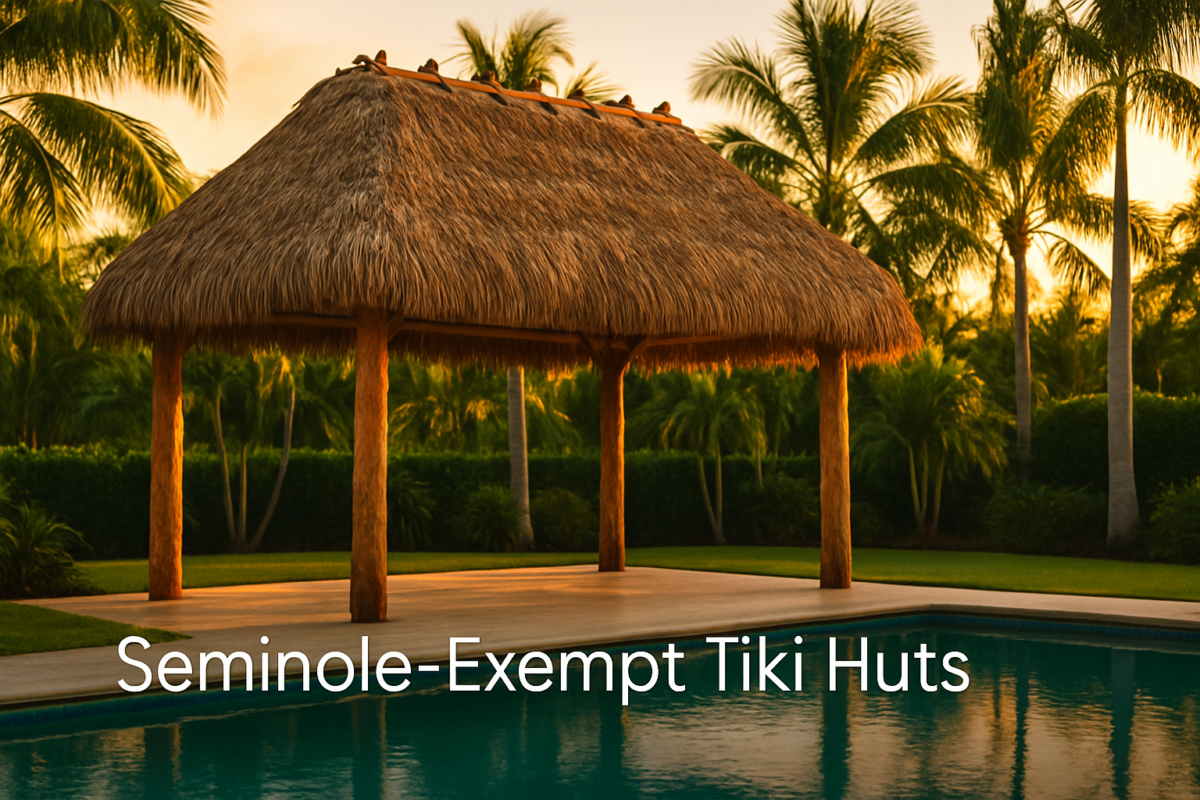
Florida Statute 553.73(10)(c) carves out a specific exception in the Florida Building Code for traditional Native American chickees. In plain English: a chickee built using authentic materials and traditional methods by members of the Miccosukee Tribe or the Seminole Tribe of Florida is not subject to the Florida Building Code in the same way a permanent structure is. That’s why you’ll hear contractors and county officials use the shorthand “Seminole-exempt” or “chickee-exempt.”

To qualify, the structure must meet a clear definition: an open-sided wooden hut with a thatched roof of palm or palmetto fronds, no electrical wiring, no plumbing, and no non-wood structural features. It cannot have enclosed walls. It cannot be built on a permanent foundation that classifies it as a habitable structure. And — this part trips a lot of people up — it has to be built by a member of the Seminole or Miccosukee tribe to fall under the exemption.

That last requirement is exactly why working with the right builder matters. Not every “tiki hut company” qualifies. The team at Big Kahuna Tiki Huts partners with tribal craftsmen so the structures we deliver in South Florida actually meet the legal definition — not just the marketing one.

Why South Florida Homeowners Care About the Exemption

If you live in Miami-Dade, Broward, or Palm Beach County, you already know how strict the building permit process can be. Hurricane codes, setback rules, impact-resistant materials, engineering stamps — adding a permanent outdoor structure usually means a stack of paperwork and a few hundred to several thousand dollars in fees before a single post goes in the ground.

Seminole exempt tiki hut construction in Florida sidesteps most of that. Because authentic chickees fall outside the Florida Building Code, they typically don’t require a building permit in the traditional sense. That means:

  • No long permit waits while your backyard sits in limbo
  • No engineering plans drawn up for a non-permanent structure
  • No permit fees stacking on top of the build cost
  • Faster installation — most of our chickees go up in a day or two

For homeowners in Miami, Fort Lauderdale, Boca Raton, and Pompano Beach who want a real tiki hut over a pool deck, patio, or backyard lounge area, the exemption is what keeps the project simple and affordable.

What the Exemption Doesn’t Cover

Here’s where we have to be straight with you, because we’ve seen plenty of homeowners get burned by contractors who oversell the exemption. Seminole-exempt status applies to the chickee itself — the cypress posts and the woven palm-frond roof. It does not automatically override every local rule.

Specifically, you still need to think about:

  • HOA covenants. If you live in a deed-restricted community in Boca Raton or a gated neighborhood in Fort Lauderdale, your HOA can still require approval for any backyard structure. The state exemption doesn’t change a contract you signed with your HOA.
  • Local zoning and setbacks. Most South Florida counties still expect chickees to respect property line setbacks, easement boundaries, and pool safety zones. We always design around those rules.
  • Electrical add-ons. The moment you add a ceiling fan, lights, an outlet, or a TV mount, you’ve added something that’s not exempt. Those electrical components require a separate permit and a licensed electrician — and we strongly recommend handling that the right way.
  • Commercial use. Restaurants, resorts, and bars using a chickee as part of a business operation may face additional fire-marshal or health-department review depending on the city.

The good news: a quality builder walks you through every one of these before the first cypress pole is delivered. We’ve helped clients in Pompano Beach navigate HOA boards and worked with restaurant owners in Miami on commercial chickee installations. It’s part of the job.

How Authentic Construction Actually Works

People sometimes assume “Seminole-exempt” is a loophole — like the structure must be flimsy to qualify. The opposite is true. Authentic chickees have weathered Florida storms for centuries because the construction is genuinely engineered for this climate.

The core of every Big Kahuna chickee is hand-selected cypress poles, sourced and prepared the traditional way. Cypress is naturally rot-resistant and stands up to humidity, salt air, and termites better than pressure-treated lumber. The roof is woven from sabal palm fronds, layered thick enough that a properly built chickee sheds water like a duck’s back and provides genuine shade — often 15 to 20 degrees cooler underneath than open sun.

Authentic Seminole exempt tiki hut construction in Florida means:

  • Cypress posts set deep into the ground, not bolted to a slab
  • Hand-tied frond layers — not sprayed-on imitation thatch
  • Open sides with no enclosed walls
  • No nails or fasteners visible in the traditional thatch work

The reward for doing it right is a structure that often lasts 8 to 12 years on the original thatch (longer with a re-thatch), looks better the older it gets, and adds real value to your property.

Choosing the Right Builder for Your South Florida Property

The Seminole exemption is a powerful advantage, but only if your builder genuinely qualifies. Before you sign a contract, ask three questions:

  1. Are the chickees built by members of the Seminole or Miccosukee tribe? (If the answer is vague, walk away.)
  2. What materials are used for the posts and the roof? (You want cypress and sabal palm, not pine and synthetic thatch.)
  3. Can I see local installations and references? (Reputable Florida builders will have plenty.)

Big Kahuna Tiki Huts has been answering those exact questions for residential and commercial clients across Miami, Fort Lauderdale, Boca Raton, and Pompano Beach for years. We provide free 3D renderings before construction so you can see exactly how the chickee will fit your space, and our portfolio includes everything from intimate poolside huts to full commercial tiki bars. Take a look at our portfolio to see what’s possible.

Ready to Plan Your Chickee?

The Seminole-exempt rule is one of the few corners of Florida construction law that actually makes life easier for homeowners — but only when you work with a builder who understands and respects the requirements. Whether you’re picturing a backyard escape in Boca Raton, an entertainment hub in Fort Lauderdale, a poolside retreat in Miami, or a commercial bar in Pompano Beach, an authentic chickee delivers tropical character that no permitted pavilion can match.

Call Big Kahuna Tiki Huts at 1-877-249-4038 or visit palmhuts.com for a free quote. We’ll walk you through the exemption, the design, and the timeline — and you’ll have a real tiki hut in your backyard before you know it.

Categories
Tiki Blog

Why You Need a GC License for Commercial Tiki Hut Builds in Florida

If you own a restaurant in Jupiter, a beachfront resort in Stuart, a waterfront bar in Jensen Beach, or a luxury community clubhouse in West Palm Beach, you already know that a custom tiki hut can transform any commercial space into a tropical destination. What many business owners don’t realize, however, is that Florida’s commercial construction rules are very different from residential ones. When a tiki hut sits on a commercial property, state and county code enforcement treats it like any other commercial structure — and that means you need a licensed professional handling the build.

At Big Kahuna Tiki Huts, we’ve been designing and building authentic cypress-pole, sabal-palm-frond tiki huts and tiki bars across Florida for decades. In this post, we’ll explain why hiring a contractor who holds a general contractor license commercial tiki hut Florida builders can legally pull is not just a good idea — it’s the difference between a protected investment and an expensive liability.

What Florida Law Says About Commercial Tiki Hut Construction

Florida Statute 489 and the Florida Building Code are clear: any structure built on commercial property that exceeds certain size thresholds, connects to utilities, is used by the public, or sits within a permitted business footprint falls under commercial construction rules. Tiki huts, or "chickees," do have certain exemptions for Seminole and Miccosukee tribal builders, but those exemptions apply almost exclusively to residential, unenclosed, primitive structures. The moment your hut is attached to a bar, covers a dining area, houses electrical service, or serves the paying public, you are in commercial-construction territory.

This is where a general contractor license commercial tiki hut Florida project owners can trust becomes non-negotiable. A licensed GC can pull permits in every Florida county, coordinate with inspectors, meet wind-load and fire-rating requirements, and sign off on the structural elements that protect your customers and your insurance coverage.

The Real Risks of Hiring an Unlicensed Tiki Hut Builder

We hear the same horror stories every season from property owners in Jupiter, Stuart, Jensen Beach, and West Palm Beach. An unlicensed crew offers a "cash deal" that sounds like a bargain, the hut goes up in a weekend, and then reality hits: the county issues a red tag, the insurance company refuses to cover liability, and the business owner is stuck tearing the structure down at their own cost.

Here’s what’s actually at stake when you skip the license:

  • Permit denial and stop-work orders. Code enforcement can shut down your project — and sometimes your entire business — until the structure is brought into compliance.
  • Insurance gaps. Most commercial general liability policies explicitly exclude unpermitted structures. One slip-and-fall, one storm, one patron injury, and you’re paying out of pocket.
  • Resale and refinancing issues. Unpermitted structures show up during title searches and appraisals, killing deals and dragging down property value.
  • ADA and egress violations. Commercial tiki bars must meet accessibility and emergency-exit codes. Unlicensed builders almost never account for these.
  • Personal liability exposure. If something goes wrong, the property owner — not the unlicensed builder — is usually the one a court holds responsible.

What a Licensed GC Actually Does on a Tiki Hut Project

A properly licensed general contractor does far more than swing a hammer. When Big Kahuna Tiki Huts takes on a commercial project in Southeast Florida, our licensed team handles the entire lifecycle:

  • Site evaluation and 3D rendering. Before a single cypress pole goes in the ground, we produce a full 3D design so you can see exactly how the hut will sit on your property.
  • Permit submission. We prepare engineered drawings, wind-load calculations (critical for coastal areas like Jupiter and Jensen Beach), and all supporting documents required by the local building department.
  • Code-compliant construction. Every post, truss, and frond is installed to meet Florida’s strict hurricane-zone standards.
  • Inspections and sign-offs. We coordinate with county inspectors, address any issues, and deliver a structure with a clean certificate of completion.
  • Warranty and accountability. A licensed contractor carries bonds and insurance. If a problem ever arises, you have real recourse.

Why Southeast Florida Businesses Trust Big Kahuna Tiki Huts

Southeast Florida’s coastal climate is one of the most demanding construction environments in the country. Between hurricane-force winds, salt air, humidity, and year-round sun, a tiki hut built by an unqualified crew simply won’t last. That’s why restaurants, resorts, country clubs, HOAs, and hospitality groups in Jupiter, Stuart, Jensen Beach, and West Palm Beach keep coming back to Big Kahuna Tiki Huts.

Everything we build uses authentic hand-selected cypress poles and sabal palm fronds — the same materials that have protected Florida structures for generations. Our crews are trained, our projects are permitted, and our work is backed by the kind of paperwork a commercial property owner can hand to an insurance adjuster without flinching. When you work with a builder who holds the proper general contractor license commercial tiki hut Florida counties require, you’re not just buying a structure — you’re buying peace of mind.

You can see examples of our commercial installations on our portfolio page, learn more about our team on our about page, or reach out through our contact page to get started.

Questions to Ask Before Hiring Any Commercial Tiki Hut Builder

Before you sign a single contract, run through this short list with whoever is bidding your project. If they can’t answer all of these confidently, keep looking:

  • Do you hold a Florida general contractor license, and can you provide your license number?
  • Will you pull all required permits under your license?
  • Can you provide engineered drawings and wind-load calculations for my specific county?
  • What is your insurance coverage, and will you list my property as an additional insured?
  • Can I see completed commercial projects similar to mine in Southeast Florida?
  • Do you offer a written warranty that survives inspection sign-off?

A reputable builder will welcome every one of these questions. If someone dodges them or pressures you to skip the permit process, that’s your signal to walk away.

Ready to Build the Right Way?

Your commercial tiki hut should be the showpiece of your property — not a liability waiting to happen. With proper licensing, authentic materials, and decades of Florida experience, Big Kahuna Tiki Huts builds commercial projects that stand up to hurricanes, inspections, and the test of time. Whether you’re adding a poolside tiki bar to a West Palm Beach resort, a waterfront dining pavilion in Stuart, or a community amenity in Jupiter or Jensen Beach, we handle every step from design through final inspection.

Call us today at 1-877-249-4038 or visit palmhuts.com for a free quote and 3D rendering. When you’re ready to build the right way, we’re ready to build for you.

Categories
Tiki Blog

Why Big Kahuna Is Florida’s Largest Custom Tiki Hut Builder (And What That Means for You)

When you’re picturing the perfect backyard upgrade or a show-stopping poolside bar for your resort, there’s a good chance a tiki hut is somewhere in the mental sketch. But here’s a secret most homeowners don’t know: not all tiki huts are created equal, and the builder you choose matters more than the Pinterest board you pulled the inspiration from. As the largest tiki hut builder Florida custom homeowners and business owners trust, Big Kahuna Tiki Huts has spent decades perfecting the art of authentic Polynesian-style outdoor living from Orlando to Cape Canaveral, Melbourne to The Villages, and every sunny spot in between.

If you’ve been searching for a team that can design, engineer, permit, and build a tiki hut that looks amazing on day one and still turns heads a decade later, you’re in the right place. Here’s what makes Big Kahuna different—and why “the largest” in Florida actually means something.

What It Really Means to Be the Largest Tiki Hut Builder in Florida

Being the biggest isn’t just a bragging point. It translates directly into better outcomes for your project. When a builder has built thousands of huts across the state, they’ve seen every soil condition, every HOA challenge, every hurricane season, and every permitting quirk a Florida county can throw at them. That experience shows up in the details: the way cypress poles are cut and cured, the density and angle of the thatch layers, the hidden structural anchors that keep your hut standing when the wind picks up off the coast.

Big Kahuna is the largest tiki hut builder Florida custom clients call first because scale means resources. A larger team means faster timelines, dedicated 3D design specialists, crews trained in authentic Seminole-inspired thatching techniques, and the purchasing power to source the finest cypress poles and sabal palm fronds in the state. Homeowners in Orlando who want a family chickee by the pool get the same craftsmanship as a developer in Cape Canaveral commissioning a 60-foot tiki bar for a beachfront resort.

Authentic Materials: Cypress Poles and Sabal Palm Fronds, Every Time

Walk through a Big Kahuna build site and you’ll notice something right away—there’s no pressure-treated lumber hiding under decorative thatch, no synthetic plastic palm substitutes. Every hut is constructed using cypress poles harvested for their natural rot resistance and striking grain, topped with hand-woven sabal palm fronds that shed rain like nature designed them to.

Why does this matter? Because authenticity equals longevity. Sabal palm thatching, when installed correctly by trained craftsmen, can last 8 to 12 years before needing a re-thatch. Cypress poles, properly installed and sealed, can stand for decades. Compare that to lower-cost imitations that fade, crack, or harbor pests within a few seasons, and the value becomes obvious. It’s one of many reasons Big Kahuna has earned its spot as the largest tiki hut builder Florida custom projects depend on.

Serving All of Florida—From Orlando to The Villages and Beyond

Central Florida is home base for an enormous share of Big Kahuna’s work, and for good reason. The region’s mix of resort communities, growing suburban developments, active adult neighborhoods, and theme-park-adjacent vacation rentals creates constant demand for outdoor living upgrades that can handle Florida’s climate and deliver serious wow factor.

Big Kahuna regularly builds throughout Orlando, where backyard pool huts and pergola upgrades are transforming modest lots into private resort escapes. In Cape Canaveral, beachfront properties get commercial-grade tiki bars engineered for salt air and high winds. Melbourne homeowners along the Space Coast love our open-air chickees for year-round entertaining, and in The Villages, active adult communities turn to Big Kahuna for community-approved designs that bring lanai and patio spaces to life. No matter the zip code, the craftsmanship stays the same.

Residential and Commercial Projects—Under One Roof

Many builders specialize in one or the other. Big Kahuna does both, and that dual expertise is part of what keeps the company at the top of Florida’s tiki hut industry. On the residential side, we build everything from compact backyard chickees perfect for shading a hot tub, to sprawling tiki pavilions with integrated outdoor kitchens, bars, TVs, and fans. On the commercial side, we partner with resorts, restaurants, marinas, event venues, breweries, HOAs, and municipal parks to design and install custom structures that meet code, impress guests, and stand up to heavy daily use.

Our portfolio includes projects across hospitality groups, country clubs, and private estates—and our team handles engineering stamps, permitting, insurance documentation, and ongoing maintenance. Take a look at some of the work on our portfolio page to see the range of projects we’ve completed. Whether you’re adding a personal getaway or building the centerpiece of a multi-million-dollar resort, the process starts the same way: with a conversation and a custom design.

3D Renderings Before the First Pole Goes in the Ground

One of the biggest differentiators for Big Kahuna is our 3D rendering process. Before any construction begins, our design team creates detailed 3D visualizations of your custom tiki hut, positioned exactly where it will live on your property. You’ll see the exact dimensions, roof pitch, pole placement, thatching pattern, and optional add-ons like built-in lighting, ceiling fans, bar rails, or lounge-friendly layouts.

This step saves clients from the #1 frustration of any outdoor build: surprises. If the hut looks too big, we resize it. If you want to add a wraparound bar, we draft it in. If the roofline needs to complement your home’s architecture, we adjust. Only when you’re thrilled with the design do we break ground. It’s a level of service you simply don’t get from a contractor juggling a few tiki huts on the side—and it’s another reason we’ve grown into the largest tiki hut builder Florida custom clients recommend to friends, neighbors, and business partners.

Decades of Experience, Generations of Craftsmanship

Tiki hut building in Florida is part trade, part tradition. The techniques our team uses have been refined over generations, passed down from skilled craftsmen who know exactly how to weave thatch so rain rolls off rather than through, how to orient poles so the structure breathes in Florida humidity, and how to finish every detail so your hut feels like a true tropical escape—not a prefab kit.

That experience shows up everywhere: in the consistent quality of our builds, in the responsiveness of our project managers, in the post-installation support we provide, and in the re-thatching and repair services we offer years down the line. When you work with Big Kahuna, you’re not just buying a structure—you’re getting a long-term partner in your outdoor living dreams.

Ready to Build Your Custom Tiki Hut?

Whether you’re in Orlando dreaming of a shaded poolside retreat, in Cape Canaveral planning a beachside bar, in Melbourne upgrading your entertaining space, or in The Villages searching for a community-approved shade solution, Big Kahuna Tiki Huts is ready to make it happen. There’s a reason we’re the largest tiki hut builder Florida custom projects rely on—and the best way to experience it is to start a conversation.

Visit palmhuts.com to see our work, explore design ideas, or request a free quote. You can also reach our team directly at 1-877-249-4038 to talk through your vision, ask about timelines, or schedule a site visit. Paradise starts with a single pole in the ground—let’s get yours planted.

Categories
Tiki Blog

Commercial Tiki Huts Are a Real Money Maker for Florida Businesses

If you own a restaurant, resort, hotel, bar, retail shop, or any outdoor-oriented business in Florida, you already know that ambiance matters. Customers don’t just pay for food, drinks, or a place to stay — they pay for an experience. And in a state as competitive as Florida, the businesses that create the most memorable outdoor environments are the ones that win. That’s why commercial tiki huts for Florida businesses have become one of the smartest investments an owner can make — and the ROI speaks for itself.

At Big Kahuna Tiki Huts, we’ve been building commercial tiki structures across Florida for decades. From beachside bars in Fort Myers and waterfront resorts in Naples to retail attractions in Cape Coral and island escapes on Sanibel Island, our commercial tiki huts consistently help businesses attract more customers, increase dwell time, and grow their bottom line.

Why Commercial Tiki Huts Deliver Strong ROI for Florida Businesses

The return on investment for a commercial tiki hut isn’t theoretical — it’s proven. Here’s why Florida businesses keep calling us for more:

Customers stay longer. A shaded, comfortable outdoor seating area under a beautiful tiki roof encourages guests to linger. In the restaurant and bar industry, longer dwell time directly translates to higher per-table revenue. A waterfront tiki bar in Fort Myers that seats 30 additional guests under a custom structure can generate tens of thousands of additional dollars per month during peak season.

You become a destination, not just a stop. A well-built commercial tiki hut is inherently photogenic. Guests post it on social media, tag your business, and bring friends back to experience it. This kind of organic marketing is priceless — and it starts the moment your tiki structure goes up.

Usable square footage without a full buildout. Adding covered outdoor space with a tiki hut is dramatically more cost-effective than an interior expansion or a traditional covered patio. You get functional, revenue-generating space at a fraction of the cost of permanent construction.

What Types of Florida Businesses Benefit Most?

The short answer is: almost any business with outdoor space. But here are the categories where we see the highest impact from commercial tiki huts for Florida businesses:

Restaurants and bars are the most common and highest-ROI use case. Whether you’re adding a tiki bar on an existing patio in Naples or building a full outdoor dining pavilion in Cape Coral, a custom tiki structure immediately elevates the guest experience and expands your covered seating capacity.

Hotels, resorts, and vacation rentals use tiki huts to enhance poolside areas, beach access points, and guest lounge spaces. Our commercial clients include nationally recognized names like Ritz Carlton Hotels, Hyatt Resorts, Wyndham Resorts, and Turnberry Isle — and they keep coming back because the results are undeniable.

Retail and entertainment venues in high-traffic areas use tiki structures to create shaded waiting areas, outdoor checkout or demo spaces, and eye-catching storefronts. On Sanibel Island, where the tourist economy thrives on atmosphere, a distinctive tiki structure can set a business apart from every competitor on the block.

Event venues, marinas, and parks also benefit enormously. A permanent tiki pavilion transforms an open lot into a bookable event space and can open up an entirely new revenue stream with minimal ongoing overhead.

Authentic Materials, Commercial-Grade Construction

Not all tiki huts are created equal — and when you’re investing in a commercial structure, quality and durability are everything. Big Kahuna Tiki Huts builds every commercial project using freshly cut cypress poles and authentic sabal palm fronds for thatch. These materials aren’t just beautiful — they’re proven to withstand Florida’s intense summer sun, salt air, and hurricane-season storms.

We also offer synthetic thatch options for commercial clients who need zero fire-code concerns and minimal maintenance. Both options are built on structural frameworks engineered for commercial load requirements, ADA compliance, and long service life.

Every commercial tiki project begins with a consultation and a 3D rendering so you can see exactly what the finished structure will look like on your property before we break ground. We handle permitting, construction, and final inspection — so you can stay focused on running your business while we handle the build.

Commercial Tiki Hut Maintenance and Longevity

A question we hear often from commercial clients is: how long will it last? The honest answer is that a well-built Big Kahuna tiki hut — maintained properly — can serve your business for many years. Natural sabal palm thatch typically lasts four to seven years before it needs refreshing, depending on your location and exposure to the elements. When that time comes, our commercial rethatching and repair team can have your structure looking brand new with minimal downtime for your business.

We offer commercial maintenance agreements for businesses in Fort Myers, Naples, Cape Coral, and across Southwest Florida that want a set-it-and-forget-it approach. Regular inspections, proactive repairs, and scheduled rethatching keep your tiki structure looking its best year after year — protecting your investment and your brand image.

Southwest Florida’s Tiki Hut Experts: Fort Myers, Naples, Cape Coral, and Sanibel Island

Big Kahuna Tiki Huts has deep roots in Southwest Florida. We’ve completed commercial projects of all sizes across Fort Myers, Naples, Cape Coral, and Sanibel Island, and our team knows the local permitting landscape, zoning considerations, and climate conditions that affect every build in the region.

Whether you’re planning a single tiki bar for your restaurant patio in Fort Myers or a multi-structure resort complex in Naples, we have the experience, the crew, and the craftsmanship to deliver on time and on budget. We serve all of Florida from our Southwest Florida base — so no project is out of reach.

How to Get Started

The process is straightforward. You reach out, we schedule a consultation, discuss your space and goals, and provide a detailed quote along with a 3D rendering of your proposed structure. Most commercial clients are surprised by how quickly the project moves from concept to completion — and even more surprised by how quickly the structure pays for itself.

If you’ve been thinking about expanding your outdoor space, adding a tiki bar, or creating a shaded gathering area that sets your business apart, there’s no better time to act. Florida’s outdoor season runs year-round, and every month without a commercial tiki structure is revenue you’re leaving on the table.

Ready to see the ROI for yourself? Call Big Kahuna Tiki Huts at 1-877-249-4038 or visit palmhuts.com to request your free quote. Our team is ready to help you build something that makes your business unforgettable.

Categories
Tiki Blog

Tiki Hut Fire Safety in Florida: What Homeowners Need to Know

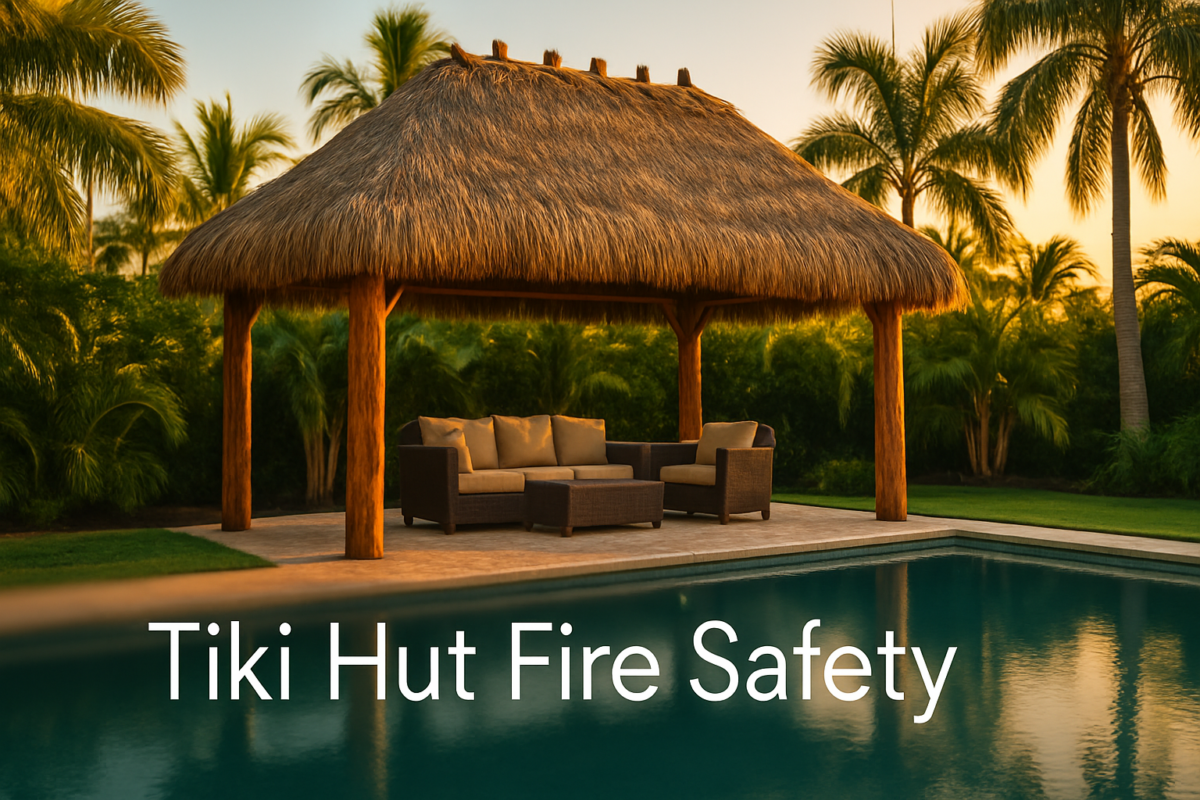
A custom tiki hut turns an ordinary Florida backyard into a shaded, breezy retreat that feels like a permanent vacation. But before you string the lights and fire up the grill nearby, there is one topic every smart owner should understand: tiki hut fire safety. Florida homeowners enjoy these authentic chickee structures year-round, and a little knowledge about materials, spacing, and maintenance goes a long way toward keeping your investment beautiful and worry-free for decades.

At Big Kahuna Tiki Huts, we have built thousands of residential and commercial structures across the state, from the beaches of Tampa and St. Petersburg down to Sarasota and Bradenton. Along the way we have learned exactly what it takes to build an authentic tiki hut that is as safe as it is stunning. This guide walks through the practical steps that make up the tiki hut fire safety Florida homeowners should prioritize from day one.

Are Tiki Huts a Fire Hazard?

Let us clear up the biggest myth first. A properly built tiki hut is not the fire trap some people imagine. Authentic tiki huts are framed with sturdy cypress poles and thatched with hand-tied sabal palm fronds, both natural materials that have sheltered Floridians for centuries. The dried palm thatch can burn if exposed to an open flame, which is exactly why responsible placement and upkeep matter so much.

The vast majority of tiki hut fires are not caused by the structure itself. They start from preventable sources: a grill placed directly beneath the thatch, an unattended fire pit too close to the poles, faulty outdoor wiring, or fireworks. Understand those risks and you have already eliminated most of the danger. That awareness is the real foundation of the tiki hut fire safety Florida homeowners can count on.

Smart Placement: Spacing Is Your First Line of Defense

The single most important fire safety decision happens before construction even begins, when you choose where the hut will stand. We recommend keeping your tiki hut a safe distance from your home, fences, sheds, and any other combustible structures. This buffer protects your hut from a house fire and protects your house from any incident at the hut.

Open-air ventilation is your friend. One reason traditional chickee design has lasted so long in Florida is that the open sides allow heat and smoke to dissipate rather than collect. When our design team plans a project for a homeowner in Tampa or Bradenton, we use 3D rendering to map exactly how the structure sits in relation to the home, pool, and landscaping, so spacing and airflow are dialed in before a single pole goes in the ground.

Keep grills, fire pits, tiki torches, and chimineas well away from the thatch and poles. If you love the idea of a fire feature near your hut, talk to us about safe placement and consider a flame feature designed for the distance. Thoughtful spacing is the cornerstone of the tiki hut fire safety Florida homeowners ask us about most.

Materials and Fire-Retardant Treatments

Authentic materials matter, and so does treating them properly. Big Kahuna builds with genuine cypress poles and natural sabal palm fronds because they deliver the real island look and stand up to Florida weather. For owners who want extra peace of mind, fire-retardant treatments are available that can be applied to the thatch to slow ignition and reduce flame spread.

These treatments are especially worth discussing for commercial properties, rental homes, and any location where local code or an insurance carrier requires them. Fire safety is not one-size-fits-all, and our team can walk you through which treatment options make sense for your specific property in St. Petersburg, Sarasota, or anywhere else in the state. You can see examples of treated and untreated builds in our project portfolio.

Florida Codes, Permits, and Insurance

Florida takes outdoor structures seriously, and tiki huts are no exception. Many counties recognize chickee huts under specific building provisions, particularly when they are built by experienced contractors using traditional methods. Requirements vary between municipalities in the Tampa Bay area, so a structure in Tampa may face slightly different rules than one in Sarasota or Bradenton.

Working with a seasoned builder takes the guesswork out of this. With decades of experience, Big Kahuna understands local permitting and can help ensure your tiki hut meets the standards that keep it both legal and safe. Proper documentation also matters for homeowners insurance, since a professionally built, code-compliant structure is far easier to insure than a questionable DIY job. When in doubt, check with your local building department and your insurance provider before construction. Meeting these standards is a big part of the tiki hut fire safety Florida homeowners depend on for long-term peace of mind.

Maintenance Keeps Your Tiki Hut Safe

A tiki hut is a living structure, and ongoing care is part of responsible ownership. Over the years, palm thatch naturally weathers and thins, and dried debris like leaves can collect on top. Periodic inspection and rethatching not only keep your hut looking sharp, they also remove excess dry material and maintain the roof at its safest, most effective thickness.

A few simple habits go a long way: clear fallen debris from the roof, keep electrical fixtures and outdoor wiring in good repair, never store flammable liquids or propane tanks underneath the hut, and keep a fire extinguisher accessible during gatherings. Routine maintenance like this rounds out the tiki hut fire safety Florida homeowners need to enjoy their backyard with total confidence. When it is time for a refresh, our crew handles rethatching and repairs across the entire Tampa Bay region, including Tampa, St. Petersburg, Sarasota, and Bradenton.

Common Tiki Hut Fire Safety Mistakes to Avoid

Even careful owners slip up, and most incidents trace back to the same short list of avoidable mistakes. The most common is positioning a charcoal or gas grill directly under the thatch to dodge the sun or rain; rising heat and stray sparks have no business near dried fronds. Another is overloading outdoor outlets with string lights, sound systems, and appliances on a single circuit, which can overheat wiring hidden in or near the poles. Owners also tend to forget the roof entirely, letting palm fronds and leaf litter pile up until the thatch is far drier and thicker than it should be.

A final mistake is treating a tiki hut like a permanent storage shed, tucking propane tanks, lighter fluid, or pool chemicals beneath it for convenience. Keep that space clear, keep flames at a respectful distance, and schedule regular inspections. Avoiding these few errors covers the large majority of real-world risk and keeps your backyard centerpiece exactly where it belongs: at the heart of the fun.

Build It Right the First Time

The surest path to a safe tiki hut is hiring a professional who knows Florida inside and out. Big Kahuna Tiki Huts serves residential and commercial clients statewide, combining authentic cypress poles and sabal palm fronds with decades of hands-on experience, 3D rendering, and a deep understanding of local codes. From a cozy backyard chickee in St. Petersburg to a sprawling commercial tiki bar in Sarasota, we build structures designed to be enjoyed safely for years to come. Learn more about our team or browse the portfolio to see what is possible.

Ready to add a stunning, safely built tiki hut to your Florida home? Call Big Kahuna Tiki Huts today at 1-877-249-4038 or visit palmhuts.com for a free quote. Let us help you create the backyard escape you have always wanted, built right and built to last.

Categories
Tiki Blog

Commercial Tiki Huts for HOA Communities and Condo Associations in Florida

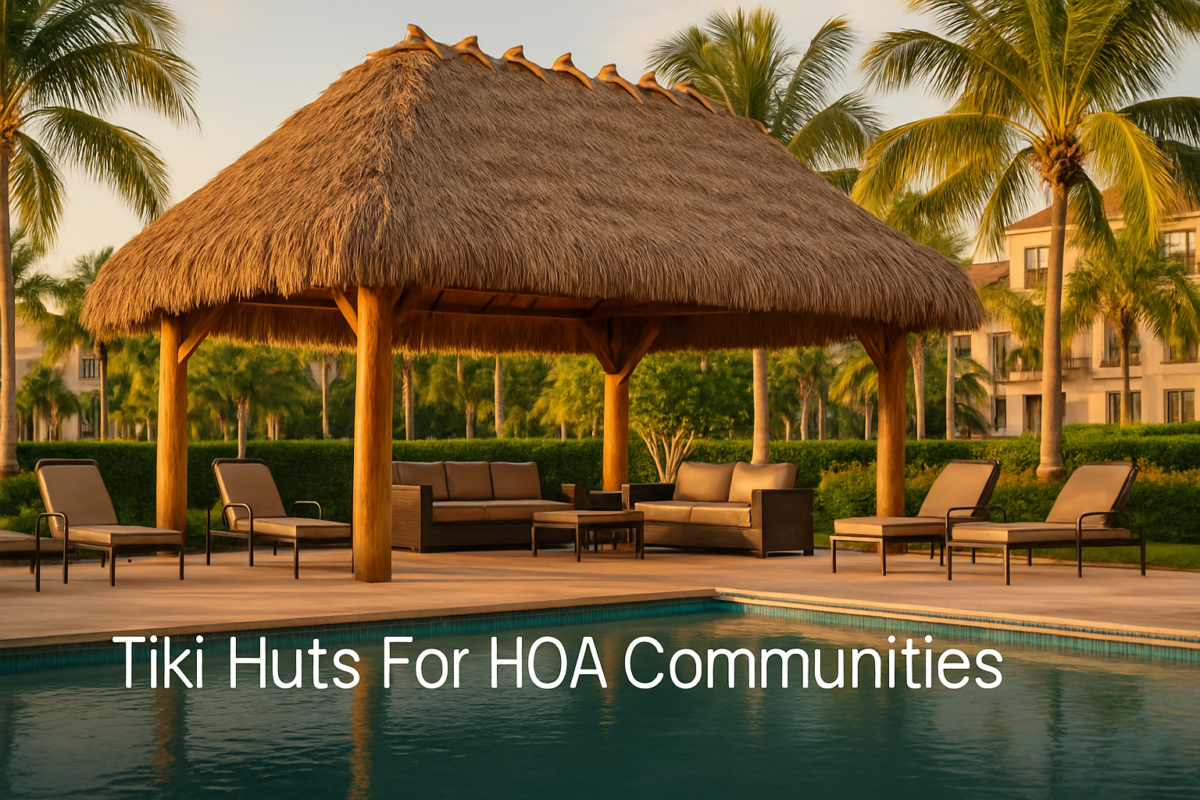
Across Florida, homeowners associations and condo boards are competing harder than ever to attract residents and boost property values. One amenity keeps rising to the top of the wish list: a beautiful, shaded gathering spot that captures the laid-back island lifestyle people move to the Sunshine State for. That is exactly why a commercial tiki hut for your HOA or condo association in Florida has become one of the smartest upgrades a community can make. It is durable, eye-catching, and instantly transforms an ordinary pool deck or common area into a resort-style destination.

At Big Kahuna Tiki Huts, we have spent decades building authentic chickees for communities up and down the state, from Southwest Florida’s coastal condos to inland HOA clubhouses. In this guide, we will walk through why these structures make so much sense for shared spaces, what sets a true commercial-grade build apart, and how we help your board navigate approvals from start to finish.

Why HOA Communities and Condo Associations Are Choosing Commercial Tiki Huts

Shared amenities are the heartbeat of any well-run community. When residents have a comfortable, shaded place to gather, the entire neighborhood feels more connected, and that translates directly into resident satisfaction and stronger property values. A commercial tiki hut delivers all of this with a fraction of the maintenance of a traditional roofed pavilion.

For condo associations along the Gulf Coast, a tiki hut by the pool or boardwalk gives residents a breezy escape from the midday sun without blocking those coveted water views. For inland HOA communities, a chickee over an outdoor kitchen or near the clubhouse creates a natural hub for events, weekend hangouts, and HOA-sponsored gatherings. Choosing a commercial tiki hut for an HOA or condo association in Florida also signals to prospective buyers and renters that the community invests in lifestyle, not just landscaping.

Just as important, these structures are built to handle heavy, ongoing use. Unlike a backyard hut that hosts the occasional family cookout, a community tiki hut sees daily traffic, so it needs to be engineered for the long haul. That is where commercial-grade construction matters. You can see examples of our community installations in our project portfolio.

What Makes a Commercial Tiki Hut Built for Shared Spaces

Not all tiki huts are created equal, and the difference is night and day when a structure has to serve dozens or hundreds of residents. A residential build prioritizes charm; a commercial build has to deliver charm and serious structural integrity.

Every commercial project we take on starts with authentic materials: hand-selected cypress poles for the frame and genuine sabal palm fronds for the roof. Cypress is naturally rot- and insect-resistant, which is critical for structures exposed to Florida’s humidity, salt air, and afternoon downpours. The sabal palm frond roof, hand-tied by experienced thatchers, sheds rain beautifully and keeps the space remarkably cool even at peak summer heat.

For an HOA or condo association, we also scale the design to match expected use. That can mean wider spans for larger crowds, reinforced posts, integrated lighting, ceiling fans, and built-in seating or bar areas. Because we handle both commercial and residential work, we know how to right-size a build so it looks gorgeous and stands up to years of community events.

Navigating HOA Approvals, Permits, and Florida Building Codes

One of the biggest hesitations boards have is the paperwork, and we get it. Adding any structure to a shared community involves architectural review committees, association bylaws, and local permitting. The good news is that we have done this many times and we make the process painless.

Before construction begins, we provide detailed 3D renderings so your board, architectural committee, and residents can see exactly what the finished tiki hut will look like in your space. This visual is invaluable for getting buy-in at community meetings and for securing approval from your HOA or condo association in Florida without the usual back-and-forth.

We also build to code. Authentic chickees enjoy unique status under Florida building regulations, and our team understands the wind-load, setback, and permitting requirements that apply to commercial installations. We coordinate with your property management company and local building departments so your association can move forward with confidence. Have questions about your specific community? Reach out through our contact page and we will walk you through it.

Serving Southwest Florida Communities From Naples to Sanibel

Southwest Florida is one of our favorite regions to work in, and it is home to some of the state’s most amenity-rich communities. We regularly build commercial tiki huts for HOA communities and condo associations across Naples, Fort Myers, Marco Island, and Sanibel Island.

In Naples, gated golf and lakefront communities use our chickees to elevate clubhouse pool decks and resident lounges. Over in Fort Myers, condo associations along the river and Gulf love how a tiki hut frames the water without obstructing views. On Marco Island and Sanibel Island, where the coastal, tropical aesthetic is everything, an authentic palm-frond roof feels right at home and holds up beautifully against salt air and sea breezes. Wherever your community sits, we serve all of Florida, so distance is never an obstacle.

Because we are a Florida company through and through, we understand the regional building requirements, the look residents expect, and the timelines associations work within. That local expertise is part of what makes a commercial tiki hut for your HOA or condo association such a dependable investment.

Design Options and Long-Term Value for Your Community

Part of the appeal of a commercial tiki hut is how flexible it is. We can build a single open-air chickee for a quiet poolside lounge, or a larger structure that anchors an entire amenity zone with an outdoor kitchen, bar seating, and entertainment space. Many associations pair their tiki hut with paver patios, string lighting, and comfortable lounge furniture to create a true outdoor living room their residents return to again and again.

And because these structures use authentic, natural materials, they age gracefully. When the sabal palm roof eventually needs refreshing after years of Florida weather, our re-thatching service restores it to like-new condition for a fraction of the cost of a full rebuild. That long lifespan, combined with low ongoing maintenance, is exactly why so many boards view a commercial tiki hut for an HOA or condo association as a sound, lasting investment rather than a passing trend.

The Big Kahuna Difference

Communities choose Big Kahuna Tiki Huts because we combine old-school craftsmanship with modern professionalism. Our decades of experience mean we have seen and solved virtually every challenge a community project can throw at us. Our 3D rendering process removes the guesswork. And our commitment to authentic cypress poles and sabal palm fronds ensures your tiki hut is the real deal, not a synthetic imitation that fades and disappoints.

We treat every association like a long-term partner. From the first site visit and design concept through permitting, construction, and future re-thatching service, we are there to keep your community’s centerpiece looking its best for years to come. Learn more about our company and the craftsmen behind every build.

Ready to Bring Resort-Style Living to Your Community?

A commercial tiki hut is more than an amenity. It is a gathering place, a property-value booster, and a statement that your community embraces the very best of the Florida lifestyle. Whether you manage a sprawling HOA or a beachfront condo association, Big Kahuna Tiki Huts has the experience, materials, and craftsmanship to bring your vision to life.

Call us today at 1-877-249-4038 or visit palmhuts.com for a free quote. Let’s build something your residents will love for decades to come.